


by Joel B. Predd, Benjamin Boudreaux, and Matt Chessen
Ask experts what the United States should do about superintelligence and you’ll get different answers. Race to a decisive lead. Build it jointly with rivals. Pause everything. Suppress superintelligence through sabotage. Or just stay out of the way of the market. Each camp has a signature argument, a theory of victory, and an account of why the others end in ruin.
Our new paper, A U.S. Strategy to Secure Geopolitical Advantage on an Uncertain Path to Superintelligence, studies the debate as a whole. It observes that seven archetypal strategies dominate the debate, each with a coherent win state and a characteristic mode of failure. The choice among them turns on a set of uncertainties that present evidence has not resolved. Committing prematurely to one strategy forecloses others through action; deferring commitment forecloses them through inaction. Switching strategies once a crisis is underway is slow, costly, and potentially destabilizing. The capabilities necessary for a given strategy must be built before the moment of need. And rivals read every U.S. decision so signals should be chosen deliberately.
For those reasons, we recommend that the United States build and preserve freedom of action across the strategy space. Under present uncertainty, this is the best approach to secure geopolitical advantage and to come through the superintelligence transition with humanity’s agency intact.
Seven Strategies, Each with a Dark Side
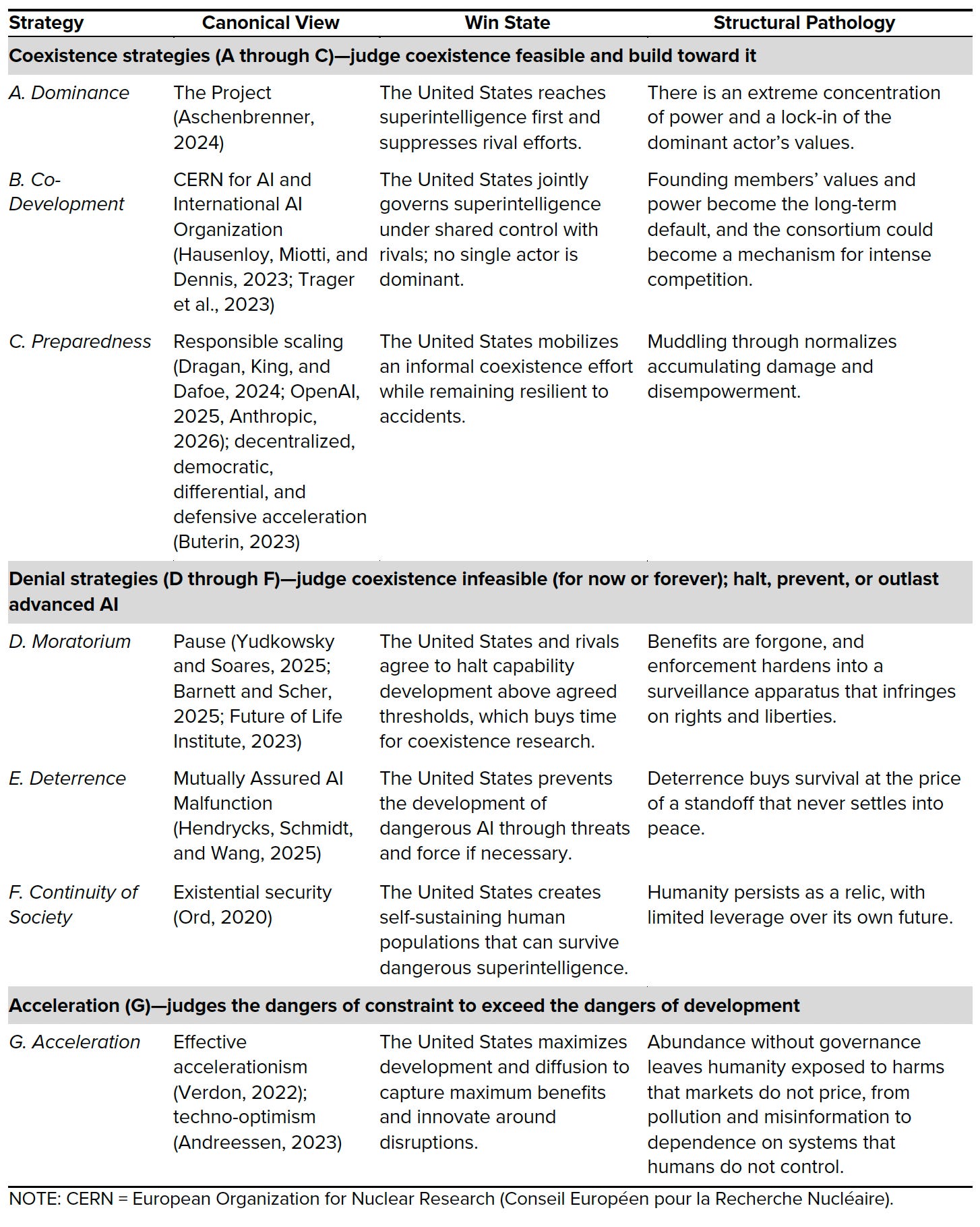
Superintelligence strategies sort into three families, summarized in Table 1 of the paper and reproduced below. Coexistence strategies (Dominance, Co-Development, Preparedness) judge that humans and superintelligence can coexist, and differ on how to build toward that outcome. Denial strategies (Moratorium, Deterrence, Continuity of Society) judge coexistence infeasible—for now or forever—and aim to halt, suppress, or outlast dangerous development.[1] Acceleration stands alone, in that it judges that the dangers of constraining AI exceed the dangers of developing it.
Each also has what we call a structural pathology, which is the way it degenerates even when it works as intended. Dominance, in success, concentrates power and locks in the winner’s values. Moratorium enforcement can harden into a global surveillance regime. Acceleration may deliver abundance, but leaves humanity exposed to harms that markets do not price. Advocates argue from their strategy’s win state; every camp has a pathology as well.
Table 1. Seven Archetypal Strategies for Frontier AI
Questions We Can’t Answer
Which strategy a decisionmaker favors depends on how they answer five questions—what the paper calls pivots. How close is the danger? Can humans and superintelligence coexist with human agency intact? Can nations and firms cooperate to restrain development? Can any single actor achieve a decisive, durable lead? And if cooperation fails, can rival programs be suppressed?
Figure 1. How the Five Pivots Resolve to Seven Strategies
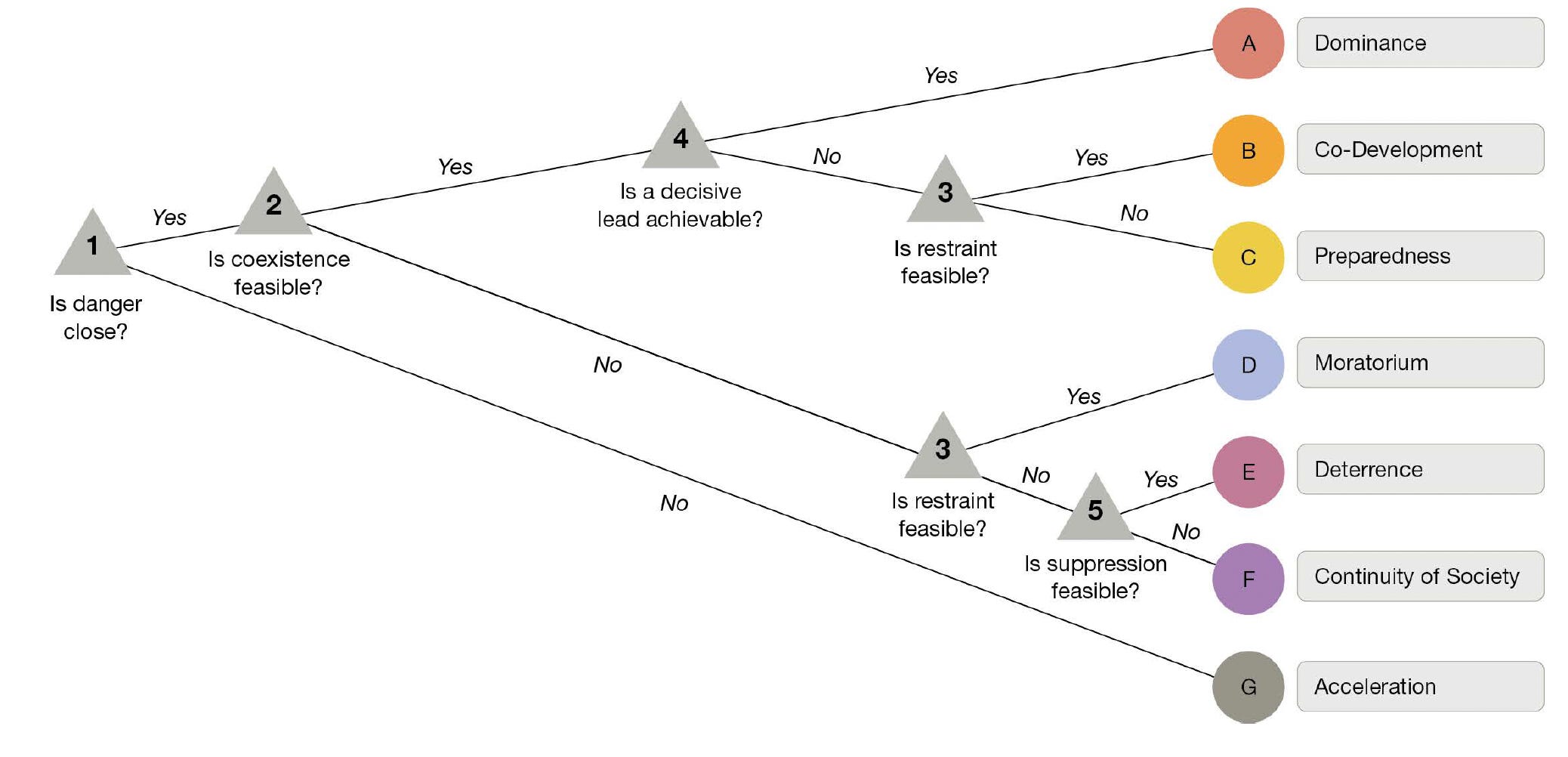
Reasonable experts can disagree on all five, and the evidence that would resolve the disagreements is asymmetric. Coexistence can be demonstrated, but never proven impossible. Suppression can be proven infeasible when an actor successfully develops advanced AI, but can never be guaranteed. For much of the strategy space, we will never have the conclusive evidence we would need.
Foreclosure Risks Are Real
One instinct is to wait until we have more evidence and then act. But waiting is also a choice, and it forecloses strategies too.
Premature commitment forecloses through action. Commit to Dominance, and the diplomatic channels, verification arrangements, and shared evaluation frameworks that Co-Development and Moratorium require can atrophy, because the logic of racing deprioritizes them. Commit to Acceleration, and AI embeds in economic and institutional life faster than governance can adapt.
Deferring choice forecloses through inaction. Several strategies depend on capabilities with long lead times—verification technology for compute, diplomatic channels, evaluation institutions, a deep coexistence research base—that take years to build and decay when unattended. A government that defers engagement while deployment continues may be executing Acceleration by default.
The paper identifies five mechanisms by which options close, each with a historical analogue: institutions decay, deployment locks in, a rival’s success renders a strategy irrelevant, knowledge diffuses irreversibly, and dependence on AI erodes the human capacity to choose.
Rivals Are Watching
The United States will not choose its strategy in a single-actor world. In a competitive environment, an AI strategy is a signal as much as it is a framework for action. A demonstrated ability to detect and defeat a covert AI program might deter one from ever being launched, but that same demonstration can convince a rival the window is closing and give it reason to sprint. Silence and ambiguity are read too. The paper’s guidance is to choose signals for their effect on the strategy space—favoring those that widen U.S. options or move rivals toward restraint, and avoiding those that do the opposite. In practice, that means demonstrating capability while signaling intent carefully, and keeping both deterrence and cooperation open.
The Recommendation: Freedom of Action
The strategy we recommend is to build and preserve freedom of action: the capacity to seize advantage as opportunities open and to pursue whichever of the seven strategies the evidence comes to favor. Freedom of action is the means, not the end. The ends remain U.S. geopolitical advantage and a transition to superintelligence that leaves humanity’s agency intact. Under present uncertainty, preserving the capacity to choose is the most reliable way to secure them.
The strategy pairs four investments with three operations. The first investment is the human-AI ecosystem: the safety and coexistence research base, the tools and institutions that keep humans in the decision seat on consequential questions, and the benefit-sharing arrangements that sustain public support. The second is the AI security architecture: situational awareness and compute visibility, incident detection and response, verification, enforcement, and counter-AI resilience. The third is adapting the legacy national security enterprise—the nuclear complex, the intelligence community, cybersecurity—to the AI era. The fourth is the capacity of citizens, firms, and governments to respond, because leaders who first encounter these dilemmas in the situation room are already behind.
In operation, the United States monitors for indications and warning on the five pivots, guards against catastrophe and lock-in while the evidence accumulates (e.g., keeping AI out of nuclear command and control absent demonstrated safeguards), and seizes advantage as windows open—signaling deliberately throughout.
Figure 2. A Freedom of Action Strategy
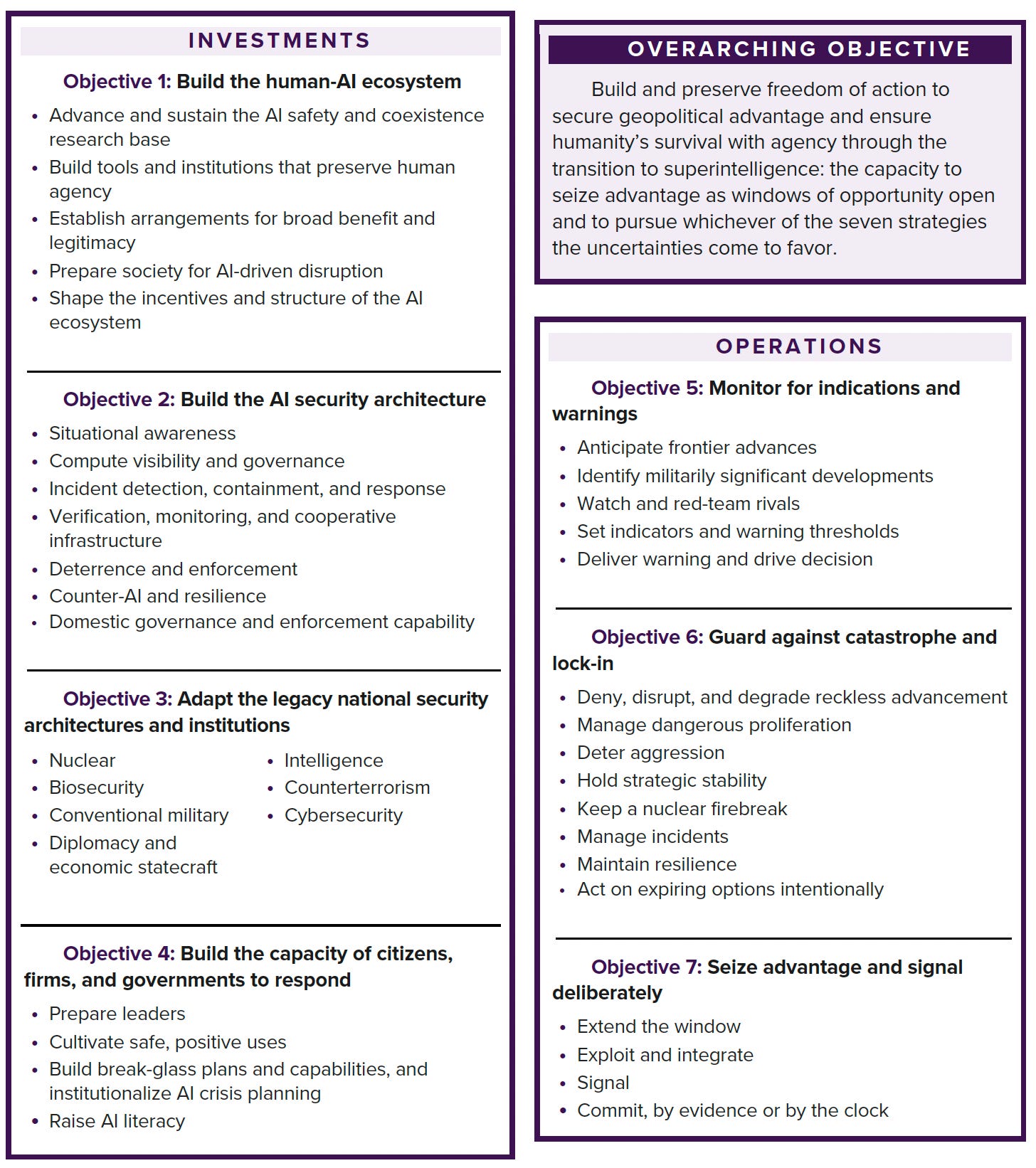
Commitment comes either by evidence or by a decision clock. When the evidence on a pivot becomes compelling, the United States should commit to the strategy that evidence favors. Short of that, each necessary capability has a latest decision date—the point beyond which its build time would exceed the time remaining before it is needed. Each date forces a deliberate choice to start building or accept foreclosure, rather than letting options expire through inaction.
Freedom of action is easy to misread as waiting. But an option exists only if it has been built, and some capabilities a given strategy requires may take years to build. The approach front loads effort now to preserve choice later.[2]
The Objections
Isn’t this expensive? Yes, and so is every alternative. Any serious national superintelligence strategy requires an investment and reorientation on par with those undertaken after World War II and in the wake of the 9/11 attacks. Maintaining optionality has a cost, but we believe that cost is dwarfed by the magnitude of commitment any superintelligence strategy will require beyond the status quo. The binding constraints for the Freedom of Action strategy are time, attention, talent, and public-private coordination, more than money.
What if timelines are too short? Short timelines raise the value of capabilities that serve several strategies at once—compute visibility, evaluation institutions, incident response—since there is less time to recover from a wrong bet. They also argue for front loading the longest-lead capabilities as crash programs.
Isn’t a foot in seven canoes a recipe for chaos? Planning for contingencies without knowing which will arrive is standard practice. The U.S. military maintains standing plans for wars that mostly never come; building the force for a single predicted war is a riskier gamble.
The Capacity to Choose and Commit
The strategy’s defining product is the capacity to commit: the ability to move decisively toward whichever strategy the evidence comes to favor, at the moment it favors it. A central risk is that institutions and processes too slow to adapt produce responses poorly matched to the speed and breadth of the challenge superintelligence creates. Little of this can be improvised mid-crisis, and every capability whose decision date passes unbuilt forecloses options. The work falls on the U.S. government, frontier AI developers, the wider business community, and civil society together, in service of the people whose agency the strategy exists to protect.
The full paper develops the strategies, the pivots, the foreclosure mechanisms, and the recommended investments in detail; a forthcoming technical report will present the comparative analysis beneath them. Read the paper on rand.org. We welcome your feedback.
Notes
1 Coexistence is defined as humans and superintelligence sharing the world on terms humans can govern. Coexistence might be realized through alignment, control, architectural constraints, or methods not yet discovered.
2 Others have also recognized the value of maintaining optionality in an environment of abundant uncertainty.